A recorder fails. A hard drive fills up overnight. Someone breaks in and takes the very box that held the evidence, so the one thing meant to protect the business ends up disappearing along with the burglar. None of this is unusual. It’s just what happens when you rely on old-fashioned CCTV for long enough, and it’s why so many business owners have started asking whether there’s a better way.
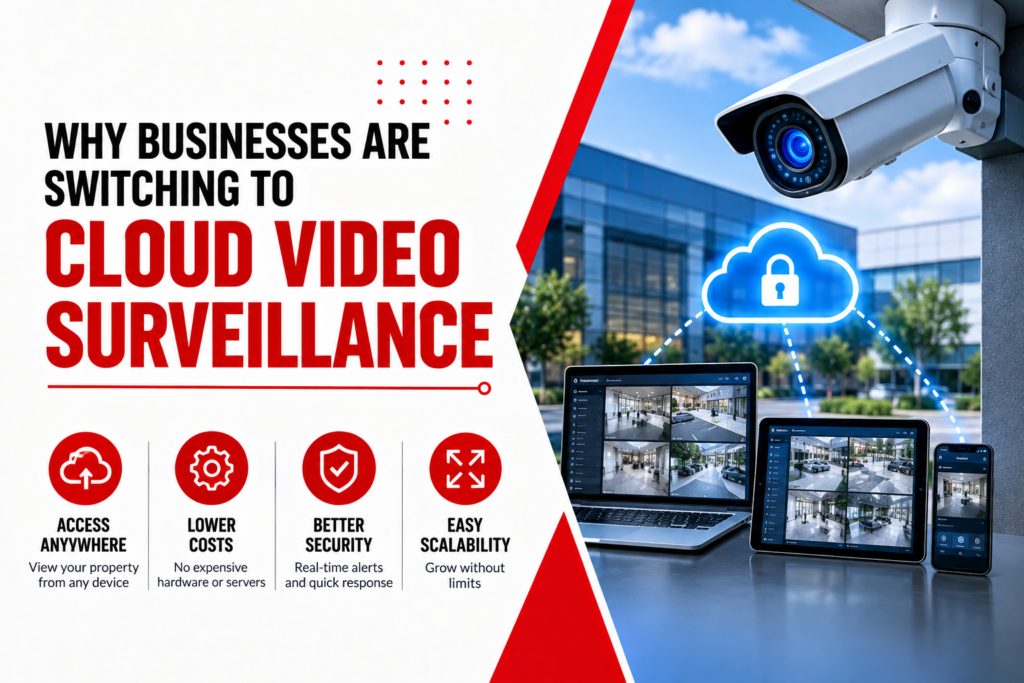
There is. It’s called cloud video surveillance, and the idea is fairly simple: instead of storing footage on a box that can be smashed, stolen, or just fill up, a cloud based video surveillance setup sends everything to secure servers offsite. You can check a camera from your phone at 2am if you want to. Pull up three sites at once. Never once worry about a hard drive quietly dying in a back office nobody’s checked in months.
This isn’t some passing trend either. Cloud video surveillance systems solve problems traditional setups have never really managed to fix. Below, we’ll get into what’s actually pushing businesses to switch, how video surveillance services compare on cost once you look past the sticker price, the mistakes people keep making, and what’s worth checking before signing with a provider.
What Is Cloud Video Surveillance?
At its core, cloud video surveillance just means your cameras send footage over the internet to secure servers rather than to a physical recorder sat in a cupboard somewhere on site. Nothing bulky to maintain. Nothing that can be smashed or carried off along with the evidence it was holding.
You log in via an app or a browser with a cloud based video surveillance system, and from there you can watch live feeds or scroll back through whatever’s been recorded. Most platforms will also ping your phone the second something odd happens, whether that’s movement after closing or a door someone forgot to lock.
Why Businesses Are Making the Move
There is no single reason businesses are moving toward cloud video surveillance systems. It’s more than a handful of practical annoyances all get solved at once, and once people see that, going back feels a bit pointless.
Cost tends to come up first. There’s no expensive recorder or on-site server to buy, install, and eventually swap out, so the upfront spend is usually a lot lighter than people assume going in. Then there’s access. A site manager doesn’t need to be sat at a desk to check footage anymore, they can pull it up from their phone on a Saturday if something feels off. And because recordings get copied off-site the moment they’re captured, stolen or damaged equipment no longer means the evidence disappears with it.
There’s also something worth saying about the businesses that switch to a proper video surveillance services provider: the whole experience just feels less stressful day to day. Mostly because there’s one number to call instead of three or four separate suppliers for cameras, storage, and repairs.
Cloud vs Traditional CCTV: What’s the Real Difference?
Traditional CCTV keeps everything local, usually on a hard drive that fills up, overwrites old footage, or just fails without much warning. If a break-in damages the recorder, whatever would’ve identified the intruder often goes with it. There’s something almost darkly funny about a security system that manages to lose its own evidence.
Cloud based video surveillance removes that weak point altogether. Footage gets copied to secure servers the moment it’s captured, so even if a camera or recorder gets smashed, everything leading up to that point is already sitting safely somewhere else.
Cost is where most assumptions fall apart. Businesses tend to expect cloud systems to be pricier, purely because of the recurring subscription. But once you add up the maintenance visits, the recorder replacements, and the callout fees that come bundled with a traditional setup, most video surveillance services actually turn out cheaper within two or three years. It’s rarely the close call people expect it to be.
How Much Does Cloud Video Surveillance Cost?
Pricing mostly comes down to three things: how many cloud video surveillance you’re running, how long footage needs to sit in storage, and what resolution you’re recording at. A small shop with four cameras and 30-day retention is going to cost nowhere near what a warehouse running twenty cameras with 90-day storage will.
Most providers charge a monthly fee per camera, and that usually covers storage, updates, and basic support in one go. Worth comparing that directly against what a traditional system actually costs over the same stretch, factoring in the recorder itself, storage drives, and whatever engineer time is needed when something breaks. Once that full picture is on the table, cloud video surveillance systems rarely turn out to be the pricier option, even if they look that way at first glance.
Data Protection and Compliance
Since footage sits off-site, it’s a fair question to ask how secure that really is. Reputable video surveillance services encrypt data both while it’s uploading and while it’s sitting in storage, which is generally a good deal more than what an unlocked recorder in a back room ever offered.
USA businesses need to think about GDPR too. Footage of people counts as personal data, so it matters where the servers physically sit, how long that footage hangs around, and who’s able to access it. A trustworthy provider of cloud based video surveillance should be able to answer every bit of that without you having to dig for it or chase them for a straight answer.
What to Look for Before Choosing a Provider
Before signing up for cloud video surveillance systems, it’s worth pinning a provider down on a few specifics. How long is footage actually kept? Is encryption used both in transit and at rest, or only one of the two? How fast does support actually respond when something’s genuinely gone wrong, not just during the sales pitch? And does the system talk to your existing alarms or access control, or is it going to sit there as its own isolated island?
A decent provider of video surveillance services should offer clear, upfront pricing with no hidden installation costs, plus a trial period so you can properly test the platform before locking into a longer contract. If a provider won’t offer a trial, that’s usually worth noting on its own.
Making the Switch to Cloud Video Surveillance
Moving away from on-site recorders solves problems businesses have quietly lived with for years: lost footage, hardware that’s gone out of date, no way to check in unless you’re physically stood on site. Cloud video surveillance fixes all three by keeping recordings safe off-site and reachable from anywhere with a connection.
If you’re weighing up cloud video surveillance systems, focus on storage retention, encryption standards, and how quickly support genuinely responds, rather than fixating on price alone. A short trial with a provider of video surveillance services is honestly the simplest way to find out whether cloud based video surveillance fits how your business actually runs day to day.
FAQ
Frequently asked questions
A virtual assistant is a remote professional who handles tasks that don’t necessarily need to be done by you. They can manage emails, schedule meetings, handle customer inquiries, manage social media, bookkeeping, project coordination, and other administrative work to free up your time for high-impact activities.
- Crystal Clear High Definition Video Surveillance
- Seamless Real Time Remote Monitoring
- Expansive Wide Angle Security Coverage
Not usually. There's a subscription to pay, sure, but businesses save on hardware, repairs, and maintenance, and that often makes cloud based video surveillance cheaper once you look at the full picture over a few years rather than the first month.
Reputable providers encrypt footage both while it's uploading and while it's sitting in storage, which typically goes well beyond whatever an on-site recorder was offering.
Yes, and honestly it's one of the biggest draws. You can check any site from a phone, tablet, or laptop, wherever you happen to be at the time.
Most systems keep a short buffer on the camera itself and upload it automatically once the connection's back, so nothing actually gets lost in the gap.
It varies by provider, but it's usually somewhere between 14 and 90 days, with longer retention often available if you're willing to pay a bit more.