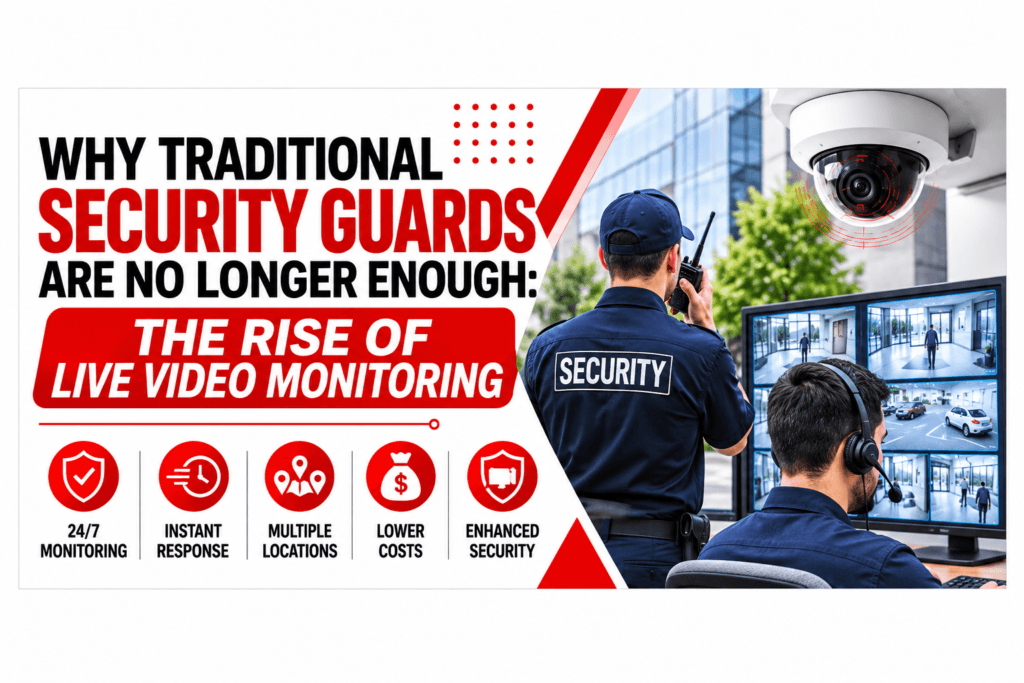
The property management companies still depend on traditional security guards, but one individual cannot be everywhere at the same time. The increasing cost of labor makes it costly to have full-time coverage. Real-time video surveillance is another method that uses trained people to monitor the live video streams.
In remote video surveillance, operators are able to confirm suspicious activity, warn via the use of speakers, and alert the police if required. This method allows for surveillance of several locations at once, unlike conventional methods. This article will compare guard monitoring vs. traditional guards in terms of cost, coverage area, police reaction, etc.
What Is Live Video Monitoring?
Live video monitoring means trained operators watch your camera feeds around the clock. The big difference from regular CCTV is simple. A real human operator takes action right away. They do not wait for you to review old videos.
When motion or an alarm triggers something happens fast. An operator sees your live feed within seconds. They look at what is actually going on. If they confirm a real threat they activate two-way audio. They speak directly to the intruder on your property. They call the police immediately with real details. A CCTV system only records what happens. Live monitoring stops problems while they are happening.
How Does Live Video Monitoring Work, Step by Step?
Live video monitoring connects security cameras and alarm sensors to trained operators at a remote monitoring centre. When an alert comes in, operators review the footage and check for signs of a real threat. They can issue a voice warning and contact emergency services when needed.
Trigger. A motion sensor sends an instant alert to the center. A door contact does the same thing. A glass-break detector also triggers the alarm.
Operator Review. A trained operator gets your camera feeds within seconds. They appear on your screen right away.
Verification. The operator watches carefully to confirm if it is real. False alarms happen all the time from wind or animals. A real threat looks very different on camera.
Deterrence. If someone is on your property the operator speaks through your speakers. They say “You are trespassing on monitored property. Police are being contacted right now.” Many intruders leave immediately when they hear a voice.
Escalation. If the intruder does not leave the operator calls police dispatch. They give real-time details about what is happening. Police know exactly what to expect when they arrive.
Report. Video footage saves automatically. Police can review what happened. This helps with prosecution later on.
Why Traditional Security Guards Fall Short
Guards can only watch one location at a time. This is the biggest problem. Intruders study patrol patterns for weeks before trying anything. They know when the guard walks which route. A guard walking the same path every thirty minutes is predictable. An intruder can steal something in the twenty-eight minute gap between rounds.
Human focus also gets worse over time. No single person can stay alert for eight hours straight. Surveillance video often shows guards checking phones or eating when something happens. This is not about being lazy. Human brains just do not work that way after a while.
There is another serious problem. Liability can cost you a lot of money. If a guard uses physical force your business might face lawsuits. If a guard falls asleep and something happens insurance may say no. They will argue you did not provide proper security. That claim might actually stick in court.
How Do Guards and Live Monitoring Compare?
Factor | On-Site Guards | Live Video Monitoring |
Coverage | One location at a time | Multiple areas at once |
Annual Cost | $168,000 to $240,000 for 24/7 | $12,000 to $36,000 plus equipment |
Response Speed | Depends on patrol location | 30 to 60 seconds always |
Deterrence | Physical presence visible | Audio warnings real-time response |
Evidence | Only if guard sees it | Automatic video recording |
Physical Intervention | Yes they can intervene | No they cannot intervene |
How Much Do Guards Cost Compared With Live Video Monitoring?
A 24/7 guard costs between $168,000 and $240,000 per year. Live monitoring plus cameras costs $12,000 to $36,000 per year. That is a huge difference.
What You Pay for Guards:
Three guards working different shifts cost about $99,840 per year. Each earns around $16 per hour. Add payroll taxes and benefits which is about 25 percent more. Add uniforms and training costs. Your total reaches $129,800 or higher per year.
What You Pay for Live Monitoring:
Monthly monitoring service for four to six cameras runs $300 to $500. That becomes $3,600 to $6,000 per year. Camera equipment costs $4,000 to $12,000 upfront. Spread over five years that is $800 to $2,400 yearly. Add backup systems which cost $1,200 to $2,400 yearly. Your total comes to $5,600 to $10,800 per year.
One retail store compared their costs directly. They paid $168,000 per year for 24/7 guards. They switched to live monitoring plus equipment for $64,000 per year. Monitoring cost only 38 percent of what guards cost. Coverage was actually better because the property was watched all the time.
If you currently spend $150,000 on guards you could save between $100,000 and $140,000 each year. That money can go to other things your business needs.
What Can Live Monitoring Not Do and When Do You Still Need a Guard?
Operators sit far away so they cannot physically intervene. They cannot unlock doors for emergency responders. They cannot escort a visitor to a meeting. They cannot respond to medical emergencies on-site.
Some facilities absolutely need on-site people. Hospitals have patients twenty-four hours a day. Data centers have critical equipment that needs physical checks. Jewelry stores have high-value items in one location. Businesses like these often use both monitoring and a guard.
Most businesses do better with a hybrid approach. Live monitoring runs all night and all weekend. A part-time guard works during business hours. They handle visitor escort and physical tasks. This combination gives you full coverage at much lower cost than guards alone.
What Is Video Alarm Verification and How Does It Change Police Response?
Video alarm verification is simple. Police get video proof that an alarm is real. They do not just get an automated signal. This changes how police respond.
Most police departments get flooded with false alarms. In Hamilton Ontario police answered over 3,000 alarms in 2018. They judged 95 percent as false. This wastes police time and delays real emergencies. So police started a video verification program on September 1 2019. Now they prioritize alarms backed by actual video evidence.
In USA police respond to property alarms only when verified. They need video or audio evidence. In Chula Vista California verified alarms get top priority dispatch. Response time drops from 45 plus minutes to 8 to 15 minutes. That difference matters when a break-in is happening right now.
False alarms cost you money too. York Regional Police charges $240 plus tax per false alarm dispatch. Multiple false alarms add up to thousands quickly. Video verification cuts false alarms dramatically because operators confirm threats first.
What Are Virtual Security Guards?
Virtual security guards are operators who watch your live feeds in real time. They verify threats and communicate with your property through two-way audio. They are different from basic monitoring which just records video.
A virtual guard speaks to intruders the moment they see them. They say “You are trespassing on monitored property. Police are on the way.” Many intruders leave right away when they hear a real voice. Virtual guard service costs more than basic monitoring. It costs less than hiring an actual person on-site. The service focuses on active deterrence and stopping incidents fast.
How Do You Choose a Live Video Monitoring Service?
Before choosing a provider, compare their response times and security procedures. Make sure they can explain how they handle real threats and system failures.
- Response time: How quickly does an operator review an alert? Ask for actual performance figures.
- Operator training: How do staff verify threats and decide when to contact police?
- Police procedures: Does the provider understand local alarm verification requirements?
- Data security: How long is footage stored and who can access it?
- Backup plans: What happens if the cameras lose power or the internet goes down?
- Contract terms: Check installation fees and monthly costs. Review contract length and cancellation charges.
- Proof of service: Ask for client references and performance reports before signing.
Conclusion
Live video monitoring solves the core problem with guards. One person cannot watch multiple areas at the same time. A trained operator covers your entire property 24/7 with 30 to 60 second response time. Monitoring typically costs 30 to 40 percent of what guards cost while providing better coverage.
However most properties benefit from a hybrid approach. Live monitoring handles nights and weekends when properties are empty. On-site staff handle daytime operations and physical tasks. Before choosing a provider, verify operator training and response times. Check their police partnerships. Ask for references and confirm your local police has a video verification program.
FAQ
Frequently asked questions
A virtual assistant is a remote professional who handles tasks that don’t necessarily need to be done by you. They can manage emails, schedule meetings, handle customer inquiries, manage social media, bookkeeping, project coordination, and other administrative work to free up your time for high-impact activities.
- Crystal Clear High Definition Video Surveillance
- Seamless Real Time Remote Monitoring
- Expansive Wide Angle Security Coverage
For most properties yes absolutely. If your main concerns are theft and break-ins monitoring works better. It covers more area at lower cost. If you need physical presence for certain tasks a hybrid approach works better. Many businesses keep a part-time guard during the day.
Good providers have cellular backup systems. If there is a problem with the internet, the system automatically moves to cellular. In case of power failure, batteries back up the cameras for 4 to 8 hours. Prolonged outages may drain all available power backup. You should ask your provider about that.
In cities with verification programs the difference is dramatic. Verified alarms get Priority 1 dispatch instead of Priority 3. Response times can drop from 45 plus minutes to 8 to 15 minutes. Check with your local police to see if they have a verification program.
Yes there is a big difference. CCTV only records. Live monitoring stops incidents while happening. With CCTV you review footage after the theft. With live monitoring operators can stop intruders before they leave.
Ask for their licensing and certifications. Ask how long they have been in business. Get references from existing clients. Verify they have real staff working 24/7. Not just call forwarding. Ask detailed questions about operator training. Legitimate providers answer everything honestly.