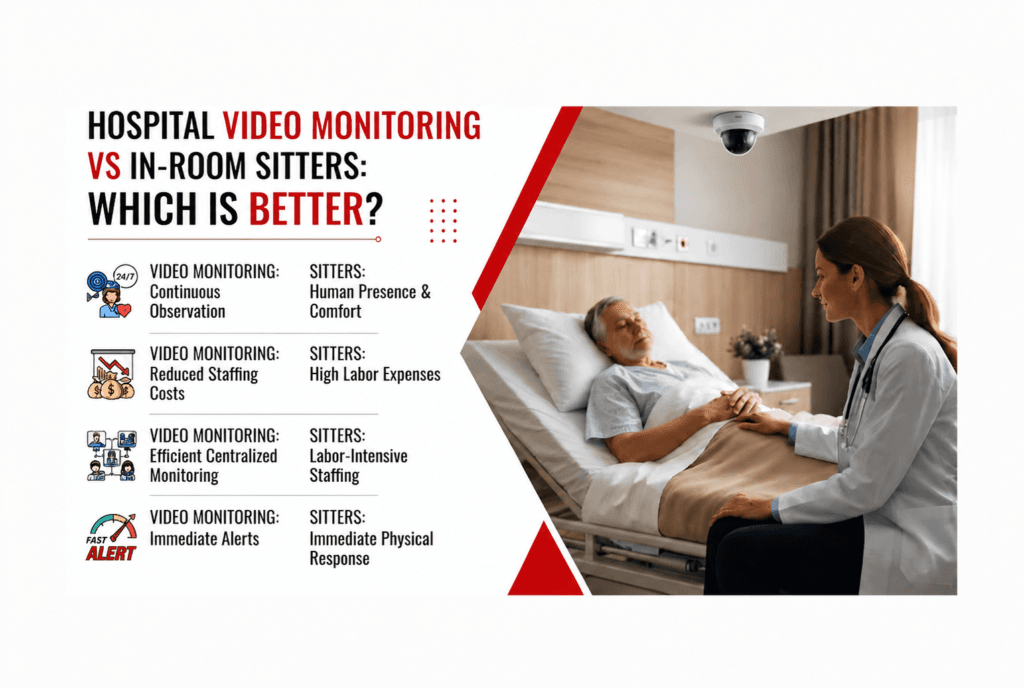
One of the primary concerns in today’s medical facilities is patient safety. Hospitals are always finding new ways to provide better patient care, prevent accidents and get a response more quickly. Many healthcare facilities would traditionally have had to use in-room sitters to supervise patients who needed constant care. But technology has come up with a smarter and more efficient alternative with hospital patient video monitoring systems.
Both options are being considered now by healthcare administrators to see which one will offer greater safety, operational efficiency and cost-effectiveness. Sitters can be present and interact with the child, while hospital patient video monitoring solutions can provide continuous monitoring with advanced surveillance technologies.
This blog examines the pros and cons, as well as some of the distinctions between the two strategies to guide hospitals in their decisions.
Understanding Hospital Patient Video Monitoring
Video monitoring in hospitals, also known as hospital patient video monitoring, is a security and patient surveillance system for healthcare providers that allows them to monitor patients remotely using cameras and digital surveillance. They are frequently used with patients who are at risk of falling, of wandering, of harming themselves, of a sudden medical event.
The trained professionals or nursing staff at a central hospital patient video monitoring station can monitor multiple patients simultaneously. The monitoring team can also be alert to local medical staff immediately if the patient needs immediate help.
Unlike the classic observation system, with hospital patient video monitoring you can see what happens in any room at all times without having to be there.
What Are In-Room Sitters?
In-room sitters are individuals who stay inside a patient’s room to provide direct supervision and support. Sitters are commonly assigned to patients with cognitive impairments, behavioral concerns, confusion, or those recovering after surgery. While traditional observation methods are still used, many hospitals now combine them with hospital patient video monitoring to improve patient safety and operational efficiency.
The primary responsibility of a sitter is to continuously observe the patient and immediately alert medical staff if intervention becomes necessary. Some sitters may also assist with non-medical tasks and provide emotional reassurance to patients during recovery. In many healthcare facilities, hospital patient video monitoring is also used alongside sitters to provide an additional layer of surveillance and faster response capabilities.
For many years, hospitals depended heavily on sitters because of their physical presence and human interaction. However, staffing shortages and rising healthcare costs have led many providers to explore smarter alternatives such as hospital patient video monitoring, which allows continuous observation while reducing operational pressure on hospital staff.
Comparing The Cost Of Both Solutions
Cost is one of the top considerations for hospital selection. In-room sitters can add up in cost because hospitals have to pay the costs of overtime, benefits, and extra staff to the in-room sitter to hire them on to cover your room.
Patient monitoring, by contrast, by using hospital patient video monitoring enables one trained employee to look at multiple patients at once. This saves considerably on labour expenses and helps to sustain the level of supervision of patients.
Hospital patient video monitoring may be more cost effective over time in hospitals that have limited budgets. The initial setup cost can be high, but the cost savings in staffing and operating costs can make it worthwhile.
The Safety And Efficiency Of Patient Monitoring
As far as patient safety is concerned, both techniques have pros. Sitters offer immediate “being there”, this can be helpful in times of emergency or emotional distress. But human observation is not necessarily consistent. Long shifts can be distracting, fatiguing or decrease the alertness of sitters.
However, hospital patient video monitoring for hospital patients can provide continuous monitoring. Patients can be watched and recorded at all times, without breaks or distractions. Higher level systems can also include audible communication, alert and motion detection to enhance response time.
Numerous hospitals have seen a decrease in patient falls and quicker responses from their emergency departments when they have adopted remote hospital patient video monitoring.
Staffing Challenges In Modern Hospitals
Staffing shortages are still a problem in healthcare facilities globally. Finding an effective sitter to work the schedule is challenging, particularly during busy patient seasons or emergency situations.
In-room sitters can be a heavy burden on the manpower of hospitals. At times nurses or healthcare assistants may find themselves reallocated as sitters and there will be a knock-on effect on the efficiency of the workflow.
Hospital patient video monitoring can help optimize hospital workforce management. Staff members can concentrate on direct patient care, with remote monitoring teams taking care of observation tasks.
The Privacy And The Comfort Of The Patient
Patient privacy is one of the important factors to take into account when using any hospital patient video monitoring. Some may feel a bit uncomfortable being scanned by a camera, particularly in a sensitive healthcare environment.
Hospital patient video monitoring should adhere to a strong privacy policy and educate patients on the system’s operation. Many facilities do not have cameras on every patient at all times but only turn them on when their patients are high risk, and provide secure encrypted systems to ensure patient information is protected.
In-room sitters can also create discomfort for patients who prefer personal space and privacy during recovery. In such cases, hospital patient video monitoring offers a less intrusive solution by allowing continuous observation without requiring someone to remain physically present in the room at all times. This approach can help patients feel more comfortable and relaxed while still ensuring their safety.
In both instances, the hospital is expected to have respect and ethical conduct in patient care.
Response Time And Emergency Handling
A fast response is crucial in healthcare settings. If a patient tries to get out of the bed, take off medical devices or if they start to become distressed, sitters can physically respond immediately.
But hospital patient video monitoring can also allow for swift action, and immediately alert nearby medical teams. Alarms and communication systems are often combined with hospital patient video monitoring solutions to speed emergency response at many hospitals.
In larger healthcare facilities, hospital patient video monitoring can help to boost efficiency, as the staff can keep an eye on multiple rooms simultaneously and have the ability to prioritize on the fly.
Integrating Technology And The Smart Healthcare Systems
With the advancement of technology, smart technologies are becoming a major feature in modern hospitals to enhance patient well-being. Hospital patient video monitoring can now be integrated with electronic medical records, nurse call systems, and AI-powered analytics.
An advanced hospital patient video monitoring solution for hospitals can be used to detect abnormal motion, fall risk and alert automatically in real-time. This forward-looking approach helps to strengthen patient security and eliminates repetitive tasks for healthcare personnel.
In-room sitter is useful, but is not as useful in terms of data analysis or technological support. With technological advancements in healthcare, hospital patient video monitoring are becoming greater in precision and efficiency.
Occasions When In-Room Sitters Are Still Valuable
Although the benefits of hospital patient video monitoring are great, in-room sitters are still valuable in some situations. Direct human contact may be beneficial for patients with severe confusion, aggression, emotional distress.
Technology cannot provide the reassurance, companionship and calming support that Sitters can. Personal care and face-to-face supervision may be more effective with pediatric or elderly patients (dementia) or psychiatric patients.
Hence, a number of hospitals choose to implement a hybrid system in which sitters are paired with hospital patient video monitoring systems for enhanced safety and efficiency.
Which Is The Better Option?
Hospital patient video monitoring provide plenty of benefits when there is a need to reduce costs, scale up operations and monitor them continuously. They are to aid in the efficiency of hospitals, optimize the staffing and improve the ability of the patient’s observations.
Personalized care, emotional support and physical presence are vital, and in-room sitters are still of great value.
Many times, doing both can be the most effective solution. Hospital patient video monitoring is available for general patients’ observation in the hospital and can be allotted to high-risk patients or emotionally vulnerable patients.
Final Thoughts
Balancing patient safety, operational efficiency and financial sustainability is of critical importance for healthcare facilities. While both sitters and hospital patient video monitoring play a part in improved patient supervision, technology is changing the way healthcare is done today.
With the increasing trend of digital healthcare solutions adopted in hospital patient video monitoring patients is gaining popularity to enhance safety and cost reduction. But in many health care scenarios, caring and interaction with humans are still vital.
FAQ
Frequently asked questions
A virtual assistant is a remote professional who handles tasks that don’t necessarily need to be done by you. They can manage emails, schedule meetings, handle customer inquiries, manage social media, bookkeeping, project coordination, and other administrative work to free up your time for high-impact activities.
- Crystal Clear High Definition Video Surveillance
- Seamless Real Time Remote Monitoring
- Expansive Wide Angle Security Coverage
n-room sitters involve a physical staff member staying directly inside a patient's room to provide continuous observation and personal support. In contrast, hospital patient video monitoring uses remote cameras and digital surveillance, allowing a single trained professional at a central station to observe multiple patients simultaneously.
Video monitoring significantly cuts down on labor expenses because one staff member can monitor several rooms at once. This reduces the heavy financial burden associated with hiring extra staff, paying overtime, and providing benefits for individual, round-the-clock physical sitters.
Yes, in-room sitters remain valuable and often necessary for patients with severe confusion, aggression, psychiatric needs, or extreme emotional distress. Technology cannot fully replicate the calming physical presence, direct companionship, and hands-on personal care that a human sitter provides.
Hospitals manage privacy by adhering to strict policies, educating patients on how systems operate, and utilizing secure, encrypted feeds. Furthermore, many facilities choose not to record or activate cameras on every patient at all times, reserving them primarily for high-risk individuals.
A hybrid system allows hospitals to optimize their workforce and operational efficiency by utilizing remote video monitoring for general or broad surveillance, while strategically deploying in-room sitters to high-risk or emotionally vulnerable patients who require direct human interaction.