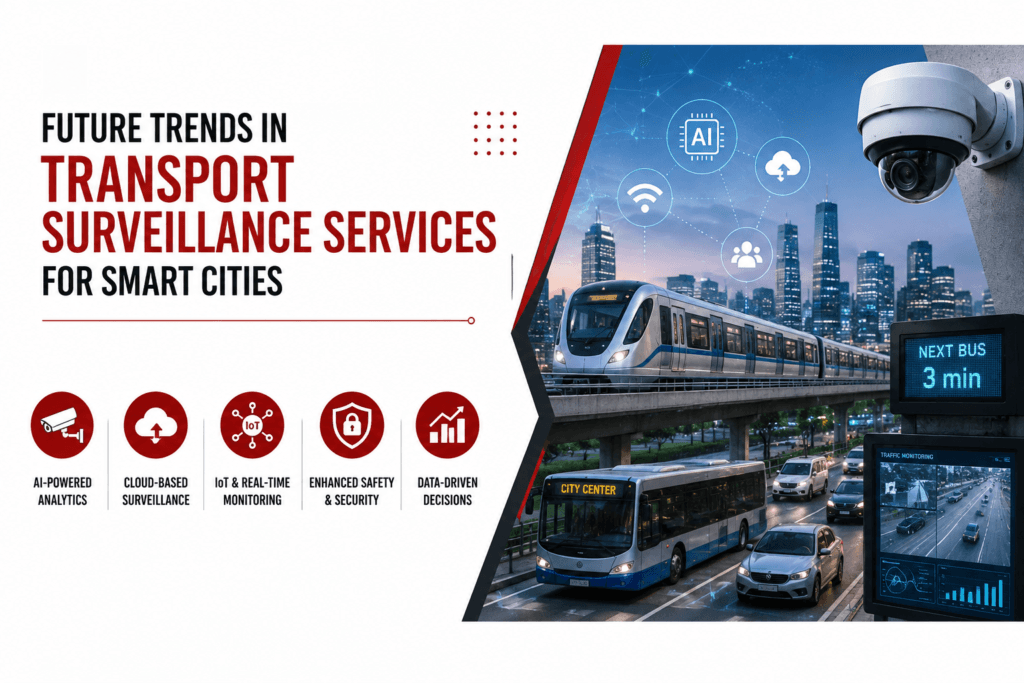
With the world’s inhabitants shifting towards urban areas, cities are quickly becoming data-driven, unified, and automatic smart ecosystems. An important element in this insurgency is transport surveillance services. No longer are these facilities simply used for monitoring, they play a vital role in safety, traffic organisation, and maintainable urban planning.
We’ll look at the new trends in transport surveillance services as well as how they are transforming smart city standards in 2026 and beyond.
The Evolution Of Transport Surveillance
Once upon a time, transport surveillance was incomplete to closed-circuit television systems at planned locations like motorways, intersections and conveyance hubs. Although successful, these were incomplete in terms of scalability, real-time dispensation and integration.
Now, smart transport surveillance services are being established using smart technologies such as artificial intelligence (AI), cloud computing and the Internet of Things (IoT). This allows cities to fold, process and respond to large quantities of data in real time.
Ai-Powered Video Analytics
A chief development in transport surveillance services is the placement of AI video analytics. Relatively than human workers, AI algorithms can be used to robotically spot irregularities like coincidences, traffic jams or doubtful behaviour.
Key Benefits:
- Real-time incident detection
- Automatic notifications to authorities
- Less manual monitoring required
AI integration makes transportation surveillance services proactive in nature instead of reactive, which means they can react faster and make things more secure.
Interfaces With Smart Traffic Management
Smart cities are hubs of connectivity and transport surveillance services are now linked with smart traffic management systems.
These platforms leverage real-time information from cameras and sensors to:
- Optimise traffic lights
- Reduce congestion
- Improve emergency response times
Transport surveillance services help cities get around faster and more effectively by integrating traffic management and surveillance.
Cloud-Based Surveillance Solutions
The cloud is revolutionising the use of transport surveillance services. Cloud-based transport surveillance services enable cities to remotely share and access data, without the need for physical storage.
Advantages:
- Growth for expanding cities
- Remote access and monitoring
- Lower maintenance costs
The move to the cloud guarantees transport surveillance services are adaptable and scalable.
Iot And Smart Infrastructure
The Internet of Things (IoT) is another game-changer for smart cities. Cameras, sensors and other devices provide detailed monitoring of the transport system.
For example:
- Intelligent cameras can talk to traffic lights
- Sensors can monitor traffic and road conditions
- Smart systems can communicate with agencies
IoT connectivity allows transport surveillance services to connect and communicate.
Advanced Biometrics, Including Facial Recognition
Safety is a vital concern in conveyance. Biometric knowledge, such as facial recognition, is progressively being used in conveyance surveillance.
These knowledges aid:
- Identify potential threats
- Enhance passenger safety
- Enhance control at transportation hubs
These technologies are highly efficient, but cities need to manage privacy issues and ensure ethical use of these technologies
Predictive Analytics For Traffic And Safety
Predictive analytics is the future of transport surveillance services as cities are able to predict issues.
By harnessing past and real-time information, systems can:
- Predict traffic congestion
- Identify accident-prone areas
- Optimise route planning
This enables the ruling classes to take a blocking stance, safeguarding urban transport is safer and more well-organised.
Surveillance and the Rise of Autonomous Vehicles
With the advent of autonomous vehicles, transport surveillance services will help keep them running.
Surveillance systems will:
- Track traffic conditions
- Communicate with autonomous vehicles
- Enforce traffic regulations
This will make the roads safer for both manned and unmanned vehicles.
Sustainability And Environmental Monitoring
Sustainability is a key theme in keen cities. Smart transport surveillance facilities help to achieve eco-friendly objectives by tracking emissions, traffic flow and oil use.
For instance:
- Supporting congestion avoidance reduces engine idling
- Vehicle flow monitoring reduces emissions
- Big data supports sustainable policies
Through their sustenance for supportable growth, transport surveillance services are an essential part of green metropolises.
Enhanced Cybersecurity Measures
With growing connectivity, cybersecurity is a dangerous issue. Data security is dynamic for trust and honesty.
Future transport surveillance services will include:
- Advanced encryption protocols
- Secure cloud storage
- Continuous system monitoring
Cybersecurity measures are critical to ensure system integrity and security.
Challenges In Implementation
However, there are challenges in implementing advanced transport surveillance services:
- High initial investment costs
- Data privacy concerns
- Integration with legacy systems
- Need for skilled professionals
To overcome these trials, it’s significant to plan and involve governments, expert retailers and stakeholders.
The Road Forward
The prospects for transport surveillance services are bright. With technological advancements, these systems will be more intelligent, efficient and faster.
Look out for:
- AI-driven automation
- Rollout of 5G
- Greater use of the cloud
- Emphasis on privacy and ethics
In the future, these transport surveillance services will not only improve safety, but they will transform the way we manage transport.
Conclusion
Intelligent systems are fundamental to the operation of smart cities, and transport surveillance services play a critical role. AI analytics, IoT connectivity, and predictive capabilities are just some of the features that are changing the face of urban transportation. They are no longer passive monitoring systems but decision-making powerhouses that assist city governments to respond quicker, better and in a more coordinated fashion.
As technology evolves, transport surveillance services will increasingly connect with other smart city technologies like emergency management systems, environmental monitoring platforms, and autonomous transportation systems. This addition will create a data-sharing network, improving urban planning, congestion management and public safety.
Traffic monitoring services are also very important for long-term success. These services improve traffic flow, cut down on congestion, and give useful information, all of which are important for lowering greenhouse gas emissions and making cities more sustainable. Public and private interest groups are recognising their contribution to sustainability.
But the future is also about being accountable. As cities become more reliant on transport surveillance services, they need to reflect issues like privacy, cybersecurity and ethical concerns for surveillance systems. Gaining public faith will be as crucial as deploying new technologies.
In summary, embracing new transport surveillance services is about more than better transport systems – it’s about creating robust, safe, future-proof cities. Governments and companies that adopt these technologies now will be well-equipped for tomorrow’s smart cities.
FAQ
Frequently asked questions
A virtual assistant is a remote professional who handles tasks that don’t necessarily need to be done by you. They can manage emails, schedule meetings, handle customer inquiries, manage social media, bookkeeping, project coordination, and other administrative work to free up your time for high-impact activities.
- Crystal Clear High Definition Video Surveillance
- Seamless Real Time Remote Monitoring
- Expansive Wide Angle Security Coverage
Transport surveillance is transitioning from simple, passive monitoring systems into intelligent, proactive decision-making powerhouses that utilize artificial intelligence, cloud computing, and IoT to improve safety and traffic organization.
AI algorithms can automatically spot irregularities like coincidences, traffic jams, or doubtful behavior. This makes surveillance proactive rather than reactive by providing real-time incident detection and automatic notifications to authorities.
Cloud-based transport surveillance services enable cities to remotely share and access data without needing physical storage. Key advantages include growth capacity for expanding cities, remote access and monitoring, and lower maintenance costs.
They help achieve eco-friendly objectives by tracking emissions, traffic flow, and oil use. For instance, supporting congestion avoidance reduces engine idling and vehicle emissions, while big data supports sustainable policies.
Key challenges include high initial investment costs, data privacy concerns, the difficulty of integration with legacy systems, and the need for skilled professionals.